
New Preprint: The Case for Personal Responsibility in Academic Error Correction
Scientific Accountability

https://www.qeios.com/read/M4GGKZ
Scientific Accountability: The Case for Personal Responsibility in Academic Error Correction
https://doi.org/10.32388/M4GGKZ
Main contents:
The contemporary scientific community has widely adopted the principle of "addressing the issue but not the person" when correcting scientific errors. This approach, while ostensibly promoting objectivity and civility, has created what we argue is a fundamentally asymmetrical system of accountability that undermines the very foundations of scientific integrity.
The prevailing "issue-only" approach to error correction represents a fundamental inequality in how scientific accountability operates. When research succeeds and generates positive outcomes, scientists rightfully receive personal recognition, career advancement, and professional acclaim. Their names become associated with discoveries, theories bear their names, and they benefit personally from their scientific contributions. However, when serious errors emerge, the same individuals who claimed personal credit are suddenly shielded behind the principle that criticism should target only the work, not the person.
Contemporary journal policies exemplify the problems created by avoiding personal accountability. Many prestigious journals, including some in materials science and applied sciences, explicitly prohibit the publication of error correction letters. Research Square refuses to accept preprints focused on error correction, while other platforms create bureaucratic obstacles that discourage error reporting.
Richard Feynman's seminal 1974 Caltech commencement address on "Cargo Cult Science" provides crucial insight into the nature of scientific integrity. Feynman identified a "specific, extra type of integrity" required of scientists—one that involves "bending over backwards to show how you are maybe wrong". This integrity, he argued, is not merely about avoiding lies but about accepting personal responsibility for one's scientific claims.
The requirement for personal accountability in science stems from the fundamental nature of scientific practice. Unlike fiction writers who may use pseudonyms, scientists publish under their real names, provide institutional affiliations, and include contact information specifically to enable direct communication about their work. This transparency reflects the understanding that scientific claims carry personal responsibility.
The transition from honest error to scientific misconduct often occurs when researchers, faced with evidence of their mistakes, choose to maintain false positions rather than accept responsibility. The current system's emphasis on avoiding personal accountability paradoxically enables this escalation by removing the social and professional incentives for prompt error correction.
When mainstream theories are challenged by contradictory evidence, a particularly troubling phenomenon emerges: the continued publication of research based on discredited foundations. This occurs despite clear evidence that the underlying theoretical framework has been refuted. The academic community often continues to publish work applying mainstream theories even after they have been scientifically disproven, creating what researchers have termed a "bandwagon effect" in academic publishing.
The principle of "addressing only the issue but not the person" becomes particularly problematic in these circumstances because it enables collective responsibility diffusion. When entire research communities continue publishing work based on discredited theories, individual researchers can justify their actions by arguing that "if everyone is wrong, then I don't need to take personal responsibility". This represents a clear manifestation of the tragedy of the commons in scientific research, where the collective pursuit of individual career advancement undermines the overall integrity of the scientific enterprise.
The case of Piero Anversa provides a stark illustration of how accusations of "destroying a research field" or "ruining careers" can be weaponized against those who identify scientific errors. Anversa, a former Harvard Medical School professor and director of the Center for Regenerative Medicine, had his research empire built on what was ultimately revealed to be fraudulent data spanning nearly two decades.
As fraudulent research persists and gains acceptance, the number of stakeholders with vested interests in maintaining the status quo grows exponentially. This phenomenon is clearly illustrated in the heart stem cell research scandal, where the extended timeline of the fraud allowed multiple layers of vested interests to develop.
This dynamic is particularly dangerous because it transforms scientific error from a technical problem into a political one. Rather than being resolved through the normal processes of scientific correction, entrenched errors require external intervention—often from regulatory agencies or institutional investigations—to be addressed. The case demonstrates how the principle of "addressing only the issue but not the person" can become a shield for protecting elaborate systems of scientific fraud.
The stakes could not be higher. As the Anversa case demonstrates, the failure to implement effective accountability mechanisms can result in the waste of billions of dollars, the destruction of promising research careers, and the delay of genuine medical advances that could save lives. The scientific community has a moral obligation to future generations to ensure that the pursuit of knowledge is guided by integrity, honesty, and personal accountability rather than by the protection of established interests and the avoidance of difficult truths.
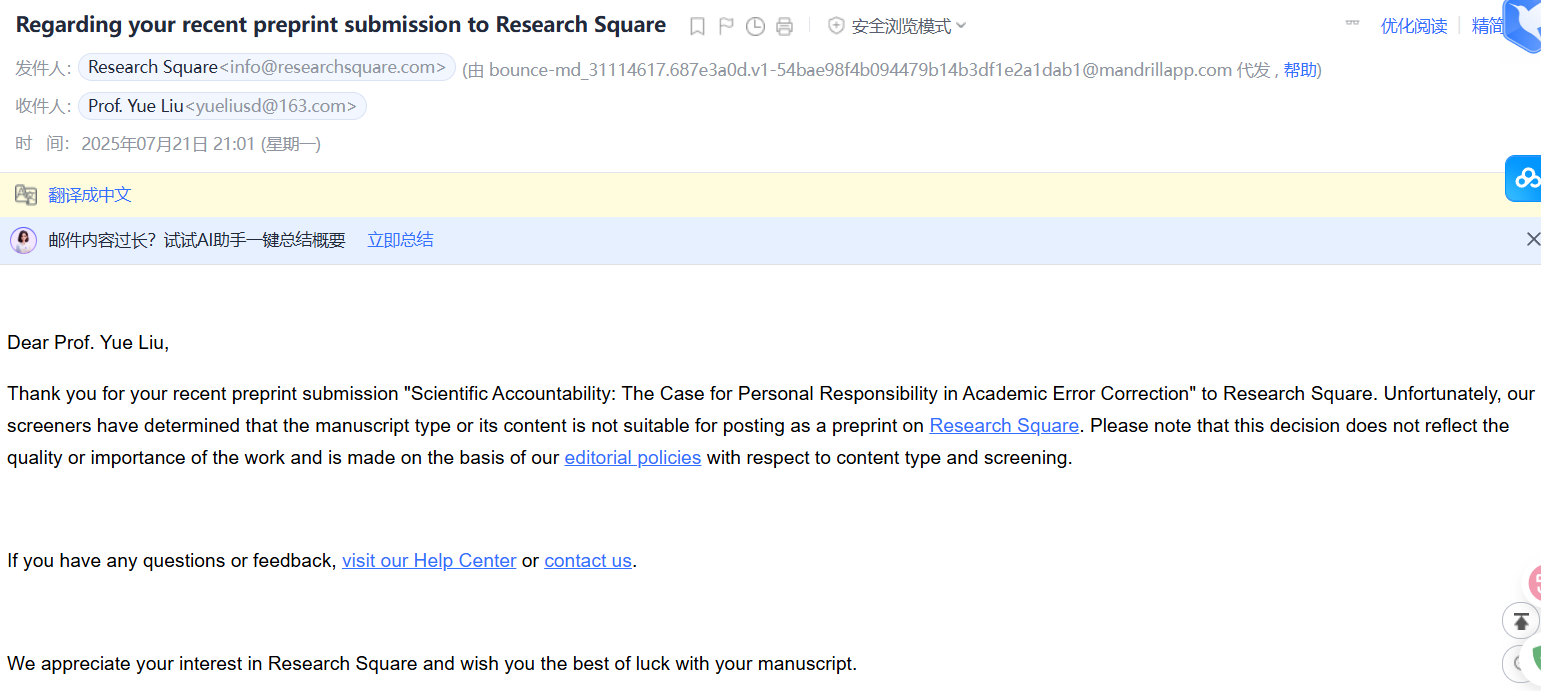
2025年07月21日 21:01 (星期一)
Dear Prof. Yue Liu,
Thank you for your recent preprint submission "Scientific Accountability: The Case for Personal Responsibility in Academic Error Correction" to Research Square. Unfortunately, our screeners have determined that the manuscript type or its content is not suitable for posting as a preprint on Research Square. Please note that this decision does not reflect the quality or importance of the work and is made on the basis of our editorial policies with respect to content type and screening.
If you have any questions or feedback, visit our Help Center or contact us.
We appreciate your interest in Research Square and wish you the best of luck with your manuscript.
Sincerely,
The Research Square Team
Research Square
A preprint platform that makes research communication faster, fairer, and more useful.
Correction is courageous
https://www.science.org/doi/10.1126/science.adm8205
Correcting Error in Academic Publishing: An Ethical Responsibility
https://link.springer.com/article/10.1007/s11673-015-9644-6
Toward fulfilling the aspirational goal of science as self-correcting: A call for editorial courage and diligence for error correction
https://onlinelibrary.wiley.com/doi/10.1111/eci.13190
DOI: https://doi.org/10.36850/dc83cd30-11ad
Cultures of Trial and Error: Identifying and Overcoming Barriers in Science Correction
https://blog.trialanderror.org/cultures-of-trial-and-error-identifying-and-overcoming-barriers-in-science-correction