

When Academic Publishing Becomes a Game of Metrics: A Case Study in Administrative Absurdity
SCI期刊参考文献的学术游戏规则
1 参考文献的作用
Liu, Yue and Liu, Ying and Drew, Michael G. B., The Fundamental Distinction Between Films and Materials: How Conceptual Confusion Led to Theoretical Errors in Microwave Absorption (September 17, 2025). Available at SSRN: https://ssrn.com/abstract=5498078 or http://dx.doi.org/10.2139/ssrn.5498078
作者以前发表过的东西没有必要在后续文章中重复。但是当我们在文章中将以前已经完成的工作用参考文献注明,审稿人不去看我们的参考文献,却说我们在文章中没有论证清楚。
微波吸收的波动力学理论只有我们在做,但是审稿人又以自引为名不让我们引用自己的工作。似乎审稿人又非常重视参考文献,实际上审稿人根本没有查看引用的文献就下结论:文章没有论证清楚、文章自引太多。
参考文献到底是干什么的?参考文献仅仅是摆设吗?
Rejection Letters as Data (Journal of Electronic Materials 1)
Liu, Yue, Self-Citation Versus External Citation in Academic Publishing: A Critical Analysis of Citation Reliability, Publication Biases, And Scientific Quality Assessment (August 14, 2025). Available at SSRN: https://ssrn.com/abstract=5392646 or http://dx.doi.org/10.2139/ssrn.5392646
2 SCI期刊参考文献的学术游戏规则
SCI期刊要求参考文献必须引用近年的,参考文献必须引用SCI顶刊文章、参考文献必须引用学术权威的文章。
Liu, Yue, From Academic Research to Academic Games: How Modern Science Lost its Way (October 31, 2025). Available at SSRN: https://ssrn.com/abstract=5684424 or http://dx.doi.org/10.2139/ssrn.5684424
Yue Liu,Ying Liu,Michael G. B Drew,Wave Mechanics of Microwave Absorption in Films: Multilayered Films, Journal of Electronic Materials, 2024, 53, 8154–8170, doi: 10.1007/s11664-024-11370-9; The wave mechanics for microwave absorption film-Part 3: Film with multilayers, Preprint, Research Square, 13 Aug, 2023,Supplementarial file, scite_
2023年09月09日 22:34 (星期六)
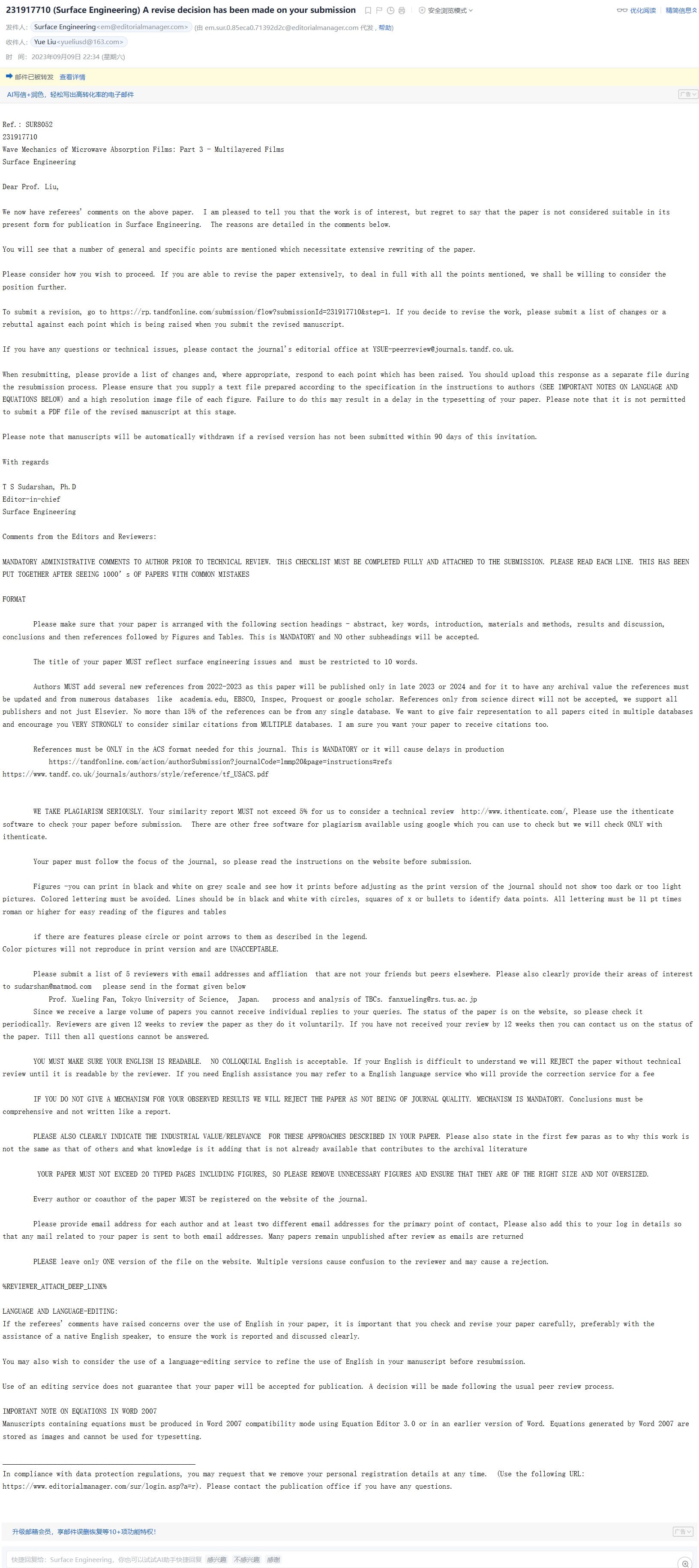

“Authors MUST add several new references from 2022-2023 as this paper will be published only in late 2023 or 2024 and for it to have any archival value the references must be updated and from numerous databases like academia.edu, EBSCO, Inspec, Proquest or google scholar. References only from science direct will not be accepted, we support all publishers and not just Elsevier. No more than 15% of the references can be from any single database. We want to give fair representation to all papers cited in multiple databases and encourage you VERY STRONGLY to consider similar citations from MULTIPLE databases. I am sure you want your paper to receive citations too.”
3 作者有权不引用任何文献
如果不引用任何文献,SCI刊物不会录用。理由是你的稿件必须承接前人研究成果、必须用参考文献表明你的文章属于期刊发表范围(要求你引用本期刊发表文章的隐晦说法)。这无疑增加了交叉学科作者进入该领域的门槛,同时扼杀前无古人的工作。
后无来者的工作。你的工作把所有工作都做完了、不会有后来的工作了,不会有在被引用的可能性了。这种稿件应该是质量高的稿件。但是因为这种稿件不能提升期刊的SCI影响因子,按现代期刊的标准也应该扼杀。
Liu, Yue, The Right to Academic Freedom: Why Scholarly Articles Should Not Require Citations and the Critique of the Academic Gaming System (September 06, 2025). Available at SSRN: https://ssrn.com/abstract=5452134 or http://dx.doi.org/10.2139/ssrn.5452134
4 你列了那么多参考文献,每一篇你都仔细阅读过吗?
列出的参考文献,不必须是每篇必须仔细读过的。
95%的都是垃圾文章,它们除了换个新材料、除了实验数据是新的、没有任何新的思想。所以只要浏览过就知道了。引用它们不仅仅是说明95%的文章都是垃圾,更是说明引用观点的普遍性。这些都是有必要的引用。
Gemini:
Based on your provided text, the video transcript, the journal editor’s email, and the cited literature, here is a comprehensive English commentary article. It is structured to critically analyze the “game rules” of academic citations, using the Surface Engineering email as a prime example of administrative absurdity.
When Academic Publishing Becomes a Game of Metrics: The “Game Rules” of References in SCI Journals
The fundamental purpose of academic publishing is to disseminate scientific truth. However, as demonstrated by a recent series of administrative hurdles imposed by the journal Surface Engineering on a manuscript titled “Wave Mechanics of Microwave Absorption Films: Part 3 - Multilayered Films,” modern publishing has mutated into a bureaucratic game.
Rather than sending the manuscript out for technical peer review, the editorial office returned it with a mandatory “administrative checklist.” At the heart of this checklist is a deeply flawed, highly weaponized approach to references. By analyzing the journal’s demands alongside the realities of academic research, we can expose the unspoken “game rules” that govern SCI (Science Citation Index) journals today.
1. The True Role of References vs. Reviewer Hypocrisy
What exactly is the purpose of a reference? Traditionally, citations allow authors to build upon previously established work without having to repeat lengthy derivations or foundational theories in every new paper.
However, a paradoxical reality exists in peer review. For example, in the study of the wave mechanics of microwave absorption, the authors are pioneers of a highly specific theoretical framework (Liu et al., 2025a). Naturally, subsequent papers must cite this foundational work. Yet, reviewers frequently ignore these citations. They will read a manuscript, fail to consult the cited literature, and subsequently reject the paper on the grounds that the authors “did not clearly demonstrate or explain their mechanisms.”
Simultaneously, these same reviewers will accuse the authors of “excessive self-citation” (Liu, 2025b). This creates an impossible Catch-22: authors are punished for explaining too much (exceeding word limits) and punished for explaining too little (relying on citations). If reviewers do not actually read the cited literature before drawing conclusions, what are references for? Are they merely decorative window dressing to satisfy journal formatting requirements?
2. The Unspoken “Game Rules” of SCI Journal Citations
The answer to the question above is found in the explicit demands of journal editors. SCI journals have established a set of unwritten (and sometimes written) game rules: references must be recent, they must come from top-tier journals, and they must cite “academic authorities.”
The email from the Surface Engineering editor makes this metric-gaming alarmingly explicit:
“Authors MUST add several new references from 2022-2023 as this paper will be published only in late 2023 or 2024 and for it to have any archival value the references must be updated... No more than 15% of the references can be from any single database... I am sure you want your paper to receive citations too.”
This is not a scientific critique; it is a business transaction. Forcing authors to arbitrarily cite papers from the last two years is a blatant tactic to artificially inflate the Impact Factor (IF) of the journal and its publishing network. Furthermore, demanding that authors balance their citations across multiple publishing databases (e.g., ScienceDirect, EBSCO, Inspec) has absolutely nothing to do with scientific validity. It is an administrative quota designed to play publisher politics (Liu, 2025c). Ultimately, the manuscript subjected to these absurd demands was published on its own scientific merit in the Journal of Electronic Materials (Liu et al., 2024).
3. The Right to Academic Freedom: The Right NOT to Cite
Under the current SCI regime, if you submit a paper without references, it will be immediately rejected. Journals justify this by claiming that all research must “build on the shoulders of giants” and that references prove a paper fits the journal’s scope (which is often a veiled demand to cite the journal’s own past articles).
This dogma stifles true scientific freedom and erects massive barriers for interdisciplinary researchers. More destructively, it kills two specific types of groundbreaking science:
Unprecedented Work (前无古人): Truly revolutionary ideas may not have direct predecessor literature to cite.
Definitive Work (后无来者): If a researcher comprehensively solves a problem, there will be no need for future papers on the topic. Consequently, the paper will not generate future citations. Because such “definitive” work cannot boost a journal’s Impact Factor, the modern publishing system deems it worthless and attempts to suppress it.
Authors should possess the fundamental right to academic freedom, which inherently includes the right not to cite literature if the work stands on its own theoretical or experimental merit (Liu, 2025d).
4. “Did You Really Read All Those References?”
There is an open secret in academia regarding the massive reference lists found at the end of modern papers. During thesis defenses, committee members will occasionally ask students: “You cited over a hundred papers. How long did it take you to read them all? Did you actually read them thoroughly?”
The honest answer is usually no—and for good reason. As many researchers know, up to 95% of published papers in certain highly saturated fields are derivative “junk.” They offer no new theoretical insights; they merely swap out one material for another, run the same tests, and publish new data.
Therefore, a researcher does not need to read every paper word-for-word; skimming is sufficient. Citing these papers is not an endorsement of their high quality. Rather, mass citation is often necessary to demonstrate the prevalence of a specific viewpoint or the widespread use of a flawed methodology within the community.
Fortunately, there is a growing pushback against citation tyranny. As noted in recent academic discourse, progressive institutions in China—such as Zhejiang University and South China University of Technology—have begun dropping reference requirements for certain practical degree theses (such as MBAs). When sending these theses out for blind review, the universities attach a note to reviewers: “Due to our university’s special requirements, please do not over-evaluate the student’s thesis based on references.”
By treating references as an absolute necessity for evaluation, the academic community allowed SCI journals to hijack the scientific method. It is time for researchers to reject the “citation game” and return the focus to what truly matters: the logic, reproducibility, and innovation of the science itself.
References
Liu, Yue; Liu, Ying; Drew, Michael G. B. (September 17, 2025a). The Fundamental Distinction Between Films and Materials: How Conceptual Confusion Led to Theoretical Errors in Microwave Absorption. Available at SSRN: https://ssrn.com/abstract=5498078 or http://dx.doi.org/10.2139/ssrn.5498078
Liu, Yue. (August 14, 2025b). Self-Citation Versus External Citation in Academic Publishing: A Critical Analysis of Citation Reliability, Publication Biases, And Scientific Quality Assessment. Available at SSRN: https://ssrn.com/abstract=5392646 or http://dx.doi.org/10.2139/ssrn.5392646
Liu, Yue. (October 31, 2025c). From Academic Research to Academic Games: How Modern Science Lost its Way. Available at SSRN: https://ssrn.com/abstract=5684424 or http://dx.doi.org/10.2139/ssrn.5684424
Liu, Yue; Liu, Ying; Drew, Michael G. B. (2024). Wave Mechanics of Microwave Absorption in Films: Multilayered Films. Journal of Electronic Materials, 53, 8154–8170. doi: 10.1007/s11664-024-11370-9. (See also Preprint, Research Square, 13 Aug, 2023).
Liu, Yue. (September 06, 2025d). The Right to Academic Freedom: Why Scholarly Articles Should Not Require Citations and the Critique of the Academic Gaming System. Available at SSRN: https://ssrn.com/abstract=5452134 or http://dx.doi.org/10.2139/ssrn.5452134
00:00:00:07 - 00:00:04:06
就像您说的 这个含金量相对来讲可能比较低
00:00:04:12 - 00:00:09:10
另外,还有其实有时候会挖坑 因为因为我记得我当初就是在答辩的时候
00:00:09:18 - 00:00:12:26
我们同组的同学有一个人像笑 就像您说的这种情况
00:00:13:06 - 00:00:16:25
参考文献写的特别多 然后我们那个答辩委员会的成员
00:00:17:09 - 00:00:20:21
就问我说你写了这么多参考文献 一共多长时间
00:00:20:21 - 00:00:25:07
把这些参考文献都都透了 看完了 因为它内部太多了 对对
00:00:25:17 - 00:00:27:17
的确会有这种情形
00:00:27:17 - 00:00:30:29
现在咱们有几个学校的话 他都不要求写参考文献 你看
00:00:30:29 - 00:00:36:00
我们要是那么开那个MBA的这个教执委 的时候 就是浙江大学
00:00:36:02 - 00:00:40:24
还有一个华南理工大学 人家学校就不要求写参考文献 就是 我就没有这一项
00:00:41:12 - 00:00:45:12
然后但是他们人也因为学校是属于比较好的一个学校 人家在评审的时候
00:00:45:12 - 00:00:49:21
就评审的那个 他会在评委的意见里边说 尊敬的评委你好
00:00:49:27 - 00:00:54:00
由于我学校的一个特殊要求 请您不要在参考文献上过多的
00:00:54:24 - 00:00:58:19
对学生的论文进行评价 就是我们学校是不要求 就是盲选的时候 对对对
00:00:58:19 - 00:01:02:19
因为刚开始的时候没写的时候很多同学人你这缺了参考文献 不让你过
00:01:03:20 - 00:01:05:27
现在他们都是这样 就自己自成一派


