
When Silence Replaces Refutation: An Open Critique of Editorial Non-Engagement and the Erosion of Scientific Self-Correction
Open Letter

“We have published this open methodological critique addressing issues of non-engagement with prior published analyses. We have shared it with the editorial office in the interest of scholarly transparency.”
The Hypocrisy of Modern Academia: When Serious Problems Are Silenced
The Polished Façade and the Silent Fire Brigade: On the Hypocrisy of Modern Academia
An Open Letter to the Scientific Community On Account Revocations, Preprint Suppression, and the Fear of Logical Critiqu
This letter addresses a matter that extends beyond any single paper, author, or journal. It concerns a methodological pattern that increasingly characterizes contemporary scientific publishing: the systematic avoidance of substantive engagement with published theoretical criticism.
Our recent work—across peer-reviewed journals, preprints, and invited reviews—has presented detailed, physics-based critiques of prevailing interpretations in microwave absorption theory, particularly regarding impedance matching, reflection loss (RL), and the quarter-wavelength model. These critiques are not speculative. They are grounded in transmission-line theory, explicit boundary conditions, and internally consistent mathematical derivations, and they have been subjected to peer review and public scrutiny.
In 2025, Advanced Electronic Materials published “On the Quality Criteria for Microwave Absorbing Materials”. The paper adopts several positions that closely align with criticisms we previously articulated—especially concerning the misuse of |RL| as a material descriptor and the conceptual confusion between films and bulk materials. Yet none of our relevant published analyses are cited, discussed, or refuted.
This silence is not a neutral act.
It quietly adopts several of our core criticisms of RL while systematically refusing to cite
When Silence Replaces Refutation: An Open Critique of On the Quality Criteria for Microwave Absorbing Materials (Adv. Electron. Mater., 2025) and a Methodological Diagnosis of Contemporary Academic Avoidance
In science, disagreement is resolved not by omission but by argument. If our analyses are incorrect, they should be shown to be so—explicitly, technically, and publicly. If they are correct or partially correct, then ethical scholarship requires acknowledgment. What is methodologically indefensible is the appearance of conceptual convergence without citation, coupled with the absence of refutation.
This case illustrates a broader methodological problem: modern scientific culture increasingly treats experimental data as self-interpreting, while theoretical structure is reduced to a rhetorical accessory. History teaches the opposite lesson. Without Rutherford’s nuclear model, scattering experiments were uninterpretable. Without Meitner’s theoretical explanation, Hahn’s fission observations would have appeared to violate mass conservation and might have been discarded. Data do not speak; theory gives them language.
When journals tolerate silence in place of refutation, they unintentionally promote a form of cargo cult science: experimental repetition without conceptual accountability, citation without intellectual continuity, and consensus without correction.
This letter is not an accusation. It is a record.
We invite editors, reviewers, and authors alike to reflect on a simple methodological question:
If valid criticism can be ignored without response, who, then, has the authority to define scientific correctness?
Scientific progress depends not on unanimity, but on the courage to answer criticism with reasoning rather than silence.
Yue Liu
(on behalf of co-authors)
On the Quality Criteria for Microwave Absorbing Materials, Adv. Electron. Mater. 2025, 11, e00239, Volume11, Issue14, September 4, 2025,e00239
https://doi.org/10.1002/aelm.202500239
Yue Liu, Scientific Accountability: The Case for Personal Responsibility in Academic Error Correction, Qeios, Preprint, 2025, https://doi.org/10.32388/M4GGKZ
Shameless Mainstream Scientists: When Silence Replaces Refutation and Credit Replaces Truth
It quietly adopts several of our core criticisms of RL while systematically refusing to cite
Shameless Mainstream Scientists: When Silence Steals More Than Credit
When Silence Replaces Refutation: An Open Critique of On the Quality Criteria for Microwave Absorbing Materials (Adv. Electron. Mater., 2025) and a Methodological Diagnosis of Contemporary Academic Avoidance
Unrecognized Insights from the Humble Few: The Forgotten Power of Minority Vision
JPhysD-127745,Referee 1:“Thank the author for his contribution to the theoretical application of quarter wavelength theory. However,
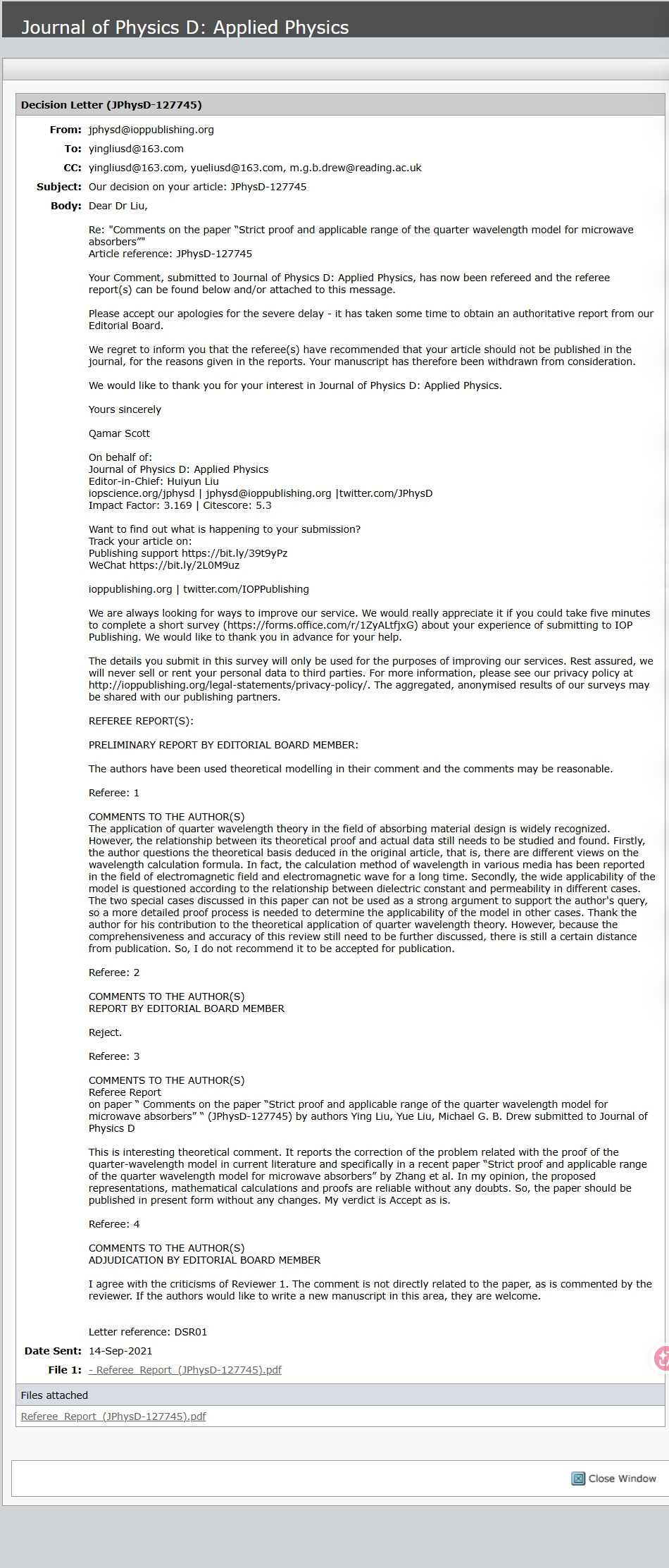
Sha Zhang, Tao Wang1, Meizhen Gao, Peng Wang, Hua Pang, Liang Qiao and Fashen Li. Strict proof and applicable range of the quarter-wavelength model for microwave absorbers,Journal of Physics D: Applied Physics 2020 Vol. 53 Issue 26 Pages 265004,DOI: 10.1088/1361-6463/ab79da, https://doi.org/10.1088/1361-6463/ab79da,
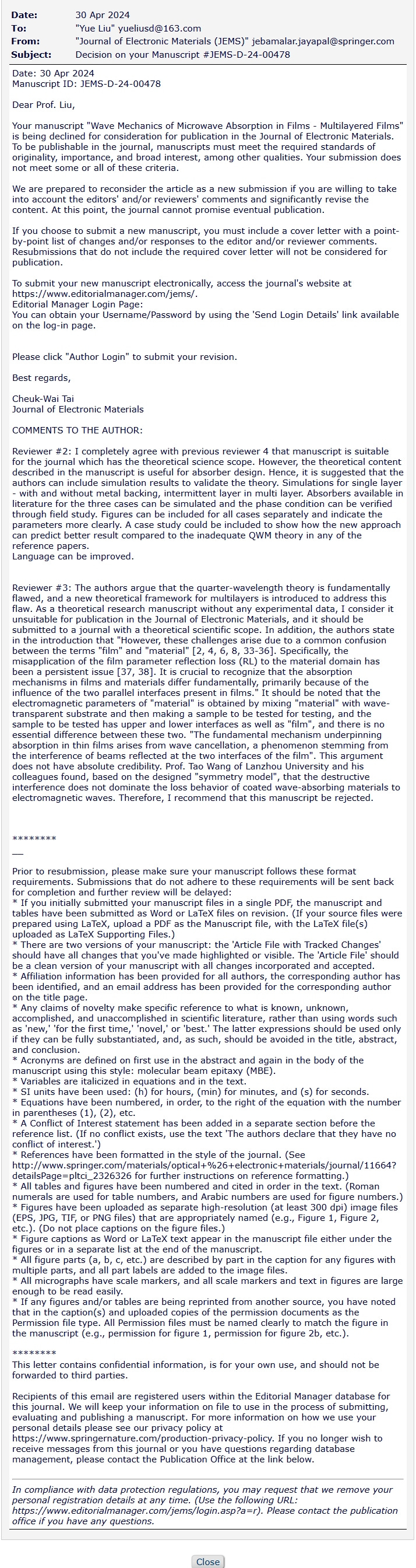
JEMS-D-24-00478, Reviewer #3: “Prof. Tao Wang of Lanzhou University and his colleagues found, based on the designed “symmetry model”, that the destructive interference does not dominate the loss behavior of coated wave-absorbing materials to electromagnetic waves. Therefore, I recommend that this manuscript be rejected.”
CEJ-D-22-28163,Reviewer #2:
T. Wang, R. Han, G. Tan, J. Wei, L. Qiao and F. Li. Reflection loss mechanism of single layer absorber for flake-shaped carbonyl-iron particle composite, Journal of Applied Physics 2012 Vol. 112 Issue 10 Pages 104903, DOI: 10.1063/1.4767365, http://dx.doi.org/10.1063/1.4767365
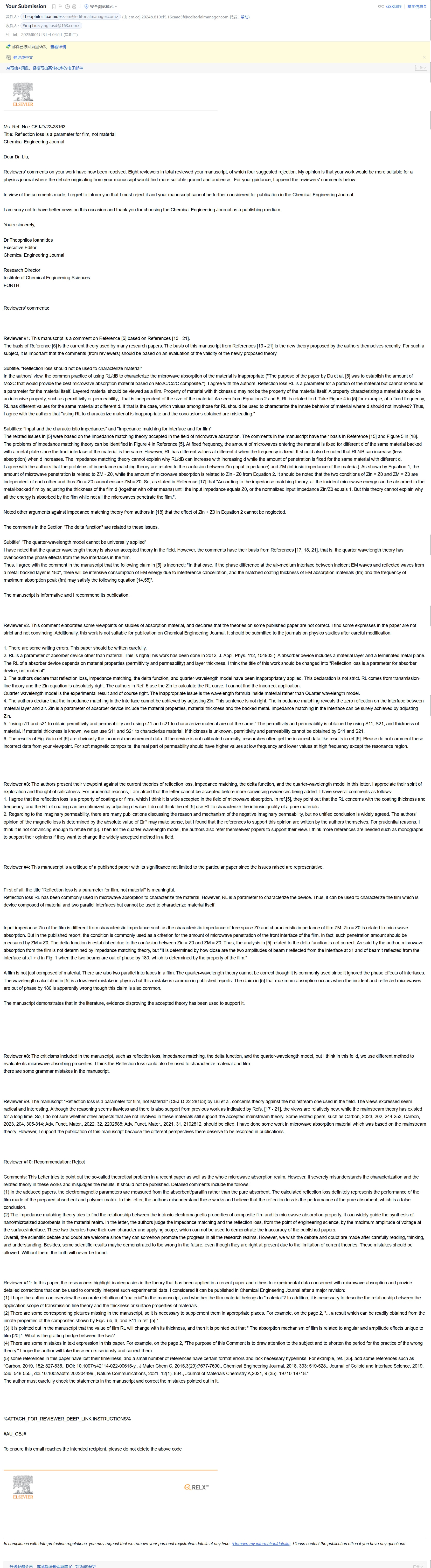
T. Wang, G. Chen, J. Zhu, H. Gong, L. Zhang and H. Wu. Deep understanding of impedance matching and quarter wavelength theory in electromagnetic wave absorption, J Colloid Interface Sci 2021 Vol. 595 Pages 1-5, Accession Number: 33813219 DOI: 10.1016/j.jcis.2021.03.132, Received 8 March 2021, Revised 22 March 2021, Accepted 23 March 2021, Available online 26 March 2021, Version of Record 1 April 2021. This paper accidentally uses the same symbol ZM for characteriatic impedance of material as we do.