

请写一篇英文文章说明:为什么95%以上的SCI顶刊论文都是垃圾
关键词:
一个博士生干翻三位985院长
顶刊造假为何屡禁不止?
编辑和审稿人的责任有人追究吗?
整个学界干什么去了?
那些发表综述文章的作者眼睛都在盯着什么?
“some scientists wondered how a questionable line of research persisted for so long … experts were just too timid to take a stand.”
Harvard calls for retraction of dozens of studies by noted cardiologist, New York Times, http://www.staradvertiser.com/2018/10/16/news/harvard-calls-for-retraction-of-dozens-of-studies-by-noted-cardiologist/. 16 Oct 2018
S. Vazire, A toast to the error detectors, Nature 2020 Vol. 577 Issue 7788 Pages 9, Accession Number: 31889172 DOI: 10.1038/d41586-019-03909-2, https://www.ncbi.nlm.nih.gov/pubmed/31889172
“Last month, I got a private Twitter message from a postdoc bruised by the clash between science as it is and how it should be. He had published a commentary in which he pointed out errors in a famous researcher’s paper. The critique was accurate, important and measured — a service to his field. But it caused him problems: his adviser told him that publishing the criticism had crossed a line, and he should never do it again.“
Perplexity.ai
Why Most Top-Tier SCI Papers Are Garbage
A doctoral student exposing fraud by senior professors is not an isolated scandal; it is a symptom of a much larger academic failure. The deeper question is not why a few famous papers were fake, but why the system allowed bad work, weak review, and institutional silence to persist for so long.
The video’s story is simple and devastating: one student, with a computer and persistence, identified paper fabrication by three elite university deans, and the entire system suddenly had to react. That matters because it shows what the official machinery failed to do. If the research community had been functioning as a real self-correcting system, such fraud should have been exposed much earlier by editors, reviewers, and colleagues.
The key problem is that scientific publishing has become a system of distributed irresponsibility. Editors can pass the paper along, reviewers can stay timid, institutions can remain silent, and senior scholars can rely on prestige to deflect scrutiny. When everyone is involved, no one is accountable. A review culture that is supposed to protect truth instead often protects hierarchy.
That is why fraud persists. It is not only because some authors are dishonest. It is also because the gatekeepers are incentivized to avoid conflict, preserve institutional relationships, and maintain the appearance of smooth operation. S. Vazire described exactly this kind of failure when a postdoc who accurately pointed out errors in a famous researcher’s paper was told he had “crossed a line” and should never do it again. The lesson is brutal: in too many cases, correcting error is treated as the problem.
This also explains why so many review articles are intellectually weak. Too many are written by authors who are watching the field from a safe distance, not interrogating its foundations. Their eyes are often fixed on consensus, reputation, and citation patterns rather than on theoretical correction. A real review should identify what the literature is hiding, what it has failed to resolve, and where the field has become structurally confused. Instead, many reviews merely recycle the approved narrative in polished language.
Liu, Yue, Self-Citation Versus External Citation in Academic Publishing: A Critical Analysis of Citation Reliability, Publication Biases, And Scientific Quality Assessment (August 14, 2025). Available at SSRN: https://ssrn.com/abstract=5392646 or http://dx.doi.org/10.2139/ssrn.5392646
The result is a flood of papers that look scientific but contribute little or nothing to real knowledge. Some are fake. Many more are formally valid but intellectually empty. They repeat methods, decorate existing frameworks, and generate publishable outputs without moving theory forward. That is why one can argue that the majority of top-tier SCI papers are garbage: they consume time, money, and attention without delivering genuine scientific advancement.
The responsibility for this crisis does not rest only with authors. Editors and reviewers are part of the system, and their responsibility is not abstract. Reviewers are expected to provide fair, constructive critique and to help detect weaknesses and duplicate publication. Editors are expected to manage integrity, not merely volume. But in practice, there is often little consequence for failure, timidity, or negligence. The system punishes the whistleblower more readily than the gatekeeper.
So what has the whole academic community been doing? Too often, it has been busy preserving incentives. Publication counts, impact factors, prestige ladders, and career survival all reward compliance. In such an environment, the academic majority can become passive, even when it knows that something is wrong. Silence becomes rational. Correction becomes risky. And fraud becomes normalized.
That is why the question of accountability is central. If no one is held responsible for approving bad work, then bad work will continue. If senior authors can fake figures, reviewers can miss obvious problems, and journals can hide behind procedure, then the literature will keep filling with papers that are technically published but scientifically worthless. The system does not merely fail to stop garbage; it helps manufacture it.
A real reform would begin by changing what is rewarded. It would stop treating publication volume as a proxy for truth. It would make editors and reviewers answerable for negligence. It would protect error detectors instead of penalizing them. And it would restore the idea that science is not a game of appearances, but a discipline of correction.
The harsh conclusion is unavoidable: if a system consistently rewards conformity, protects prestige, and punishes correction, then its journals will fill with garbage no matter how “top-tier” they are. The crisis is not only in a few fraudulent papers. It is in the structure that keeps producing them.
“While you are demanding that journal papers are wrong, a thorough case study is required. Moreover, the word “research” itself signifies that facts are re-searching. Therefore, every research is relatively correct or wrong according to the era. The writing flow of the manuscript should be more polite and professional.”
“I do not support the claim that 90% of journal articles are false. This may be true to some extent for the non-peer-reviewed publications, but still, 90% is more of an exaggeration than a scientific statement. According to Nobel laureate Honjo Tasuku, 90% of the views published by top magazines like CNS are wrong. As I said before, I see this sentence as an exaggerated formulation to alert young researchers that they should not blindly follow superstition. ”
Liu, Yue and Liu, Ying, Redefining Review Articles: Beyond Balance Toward Theoretical Innovation (September 01, 2025). Available at SSRN: https://ssrn.com/abstract=5434337 or http://dx.doi.org/10.2139/ssrn.5434337, Liu, Yue, Redefining Review Articles: Beyond Balance Toward Theoretical Innovation, Sep 01, 2025, yueliusd.substack.com
Liu, Yue, From Academic Research to Academic Games: How Modern Science Lost its Way (October 31, 2025). Available at SSRN: https://ssrn.com/abstract=5684424 or http://dx.doi.org/10.2139/ssrn.5684424
Yue Liu, Scientific Accountability: The Case for Personal Responsibility in Academic Error Correction, Qeios, Preprint, 2025, https://doi.org/10.32388/M4GGKZ
Liu, Yue, The Crisis of Peer Review: Institutional Negligence, Theoretical Bankruptcy, and the Collapse of Scientific Accountability (November 15, 2025). Available at SSRN: https://ssrn.com/abstract=5751865 or http://dx.doi.org/10.2139/ssrn.5751865
Liu, Yue, Conflict of Interest in Academic Publishing: A Question of Accountability in the Pursuit of Truth (September 11, 2025). Available at SSRN: https://ssrn.com/abstract=5470606 or http://dx.doi.org/10.2139/ssrn.5470606
Liu, Yue, Why 95% of Papers in Top-Tier SCI Journals Are Garbage: A Critical Analysis of Academic Publishing Collapse (December 14, 2025). Available at SSRN: https://ssrn.com/abstract=5918342 or http://dx.doi.org/10.2139/ssrn.5918342
Liu, Yue, Major Scientific Breakthroughs Are Not Born From Journals: A Direct Examination of AI, Microchips, and the Myth of “Gradual Academic Progress” (November 08, 2025). Available at SSRN: https://ssrn.com/abstract=5720702 or http://dx.doi.org/10.2139/ssrn.5720702
Liu, Yue, The Garbage Majority: Why Most Academic Papers Are Useless-and Why This Harms Scientific Progress (November 07, 2025). Available at SSRN: https://ssrn.com/abstract=5715843 or http://dx.doi.org/10.2139/ssrn.5715843
Liu, Yue, The Hypothetical Elimination of Science and Nature Journals: Assessing Scientific Progress and Innovation 销毁Science和Nature期刊上的全部论文,对世界科技会带来什么样的影响?, 2025, yueliusd.substack.com
Liu, Yue, The Cargo Cult Selection Mechanism: How Theoretical Incomprehension Became a Career Asset (January 07, 2026). Available at SSRN: https://ssrn.com/abstract=6033415 or http://dx.doi.org/10.2139/ssrn.6033415
Liu, Yue, Cargo Cult Science as Institutional Doctrine: How Modern Academia Transforms Empirical Rules Into Dogma While Suppressing Rigorous Theory (January 06, 2026). Available at SSRN: https://ssrn.com/abstract=6030355 or http://dx.doi.org/10.2139/ssrn.6030355
Liu, Yue, Suppression of Mathematical Rigor: Cargo Cult Science (November 21, 2025). Available at SSRN: https://ssrn.com/abstract=5824982
Yue Liu. Non-Mainstream Scientific Viewpoints in Microwave Absorption Research: Peer Review, Academic Integrity, and Cargo Cult Science, Preprints.org, preprint, 2025, DOI:10.20944/preprints202507.0015.v2, Supplementary Materials
Liu, Yue, The Theoretical Poverty of Modern Academia: Evidence of Widespread Intellectual Decline in Contemporary Scientific Research (September 05, 2025). Available at SSRN: https://ssrn.com/abstract=5463155 or http://dx.doi.org/10.2139/ssrn.5463155
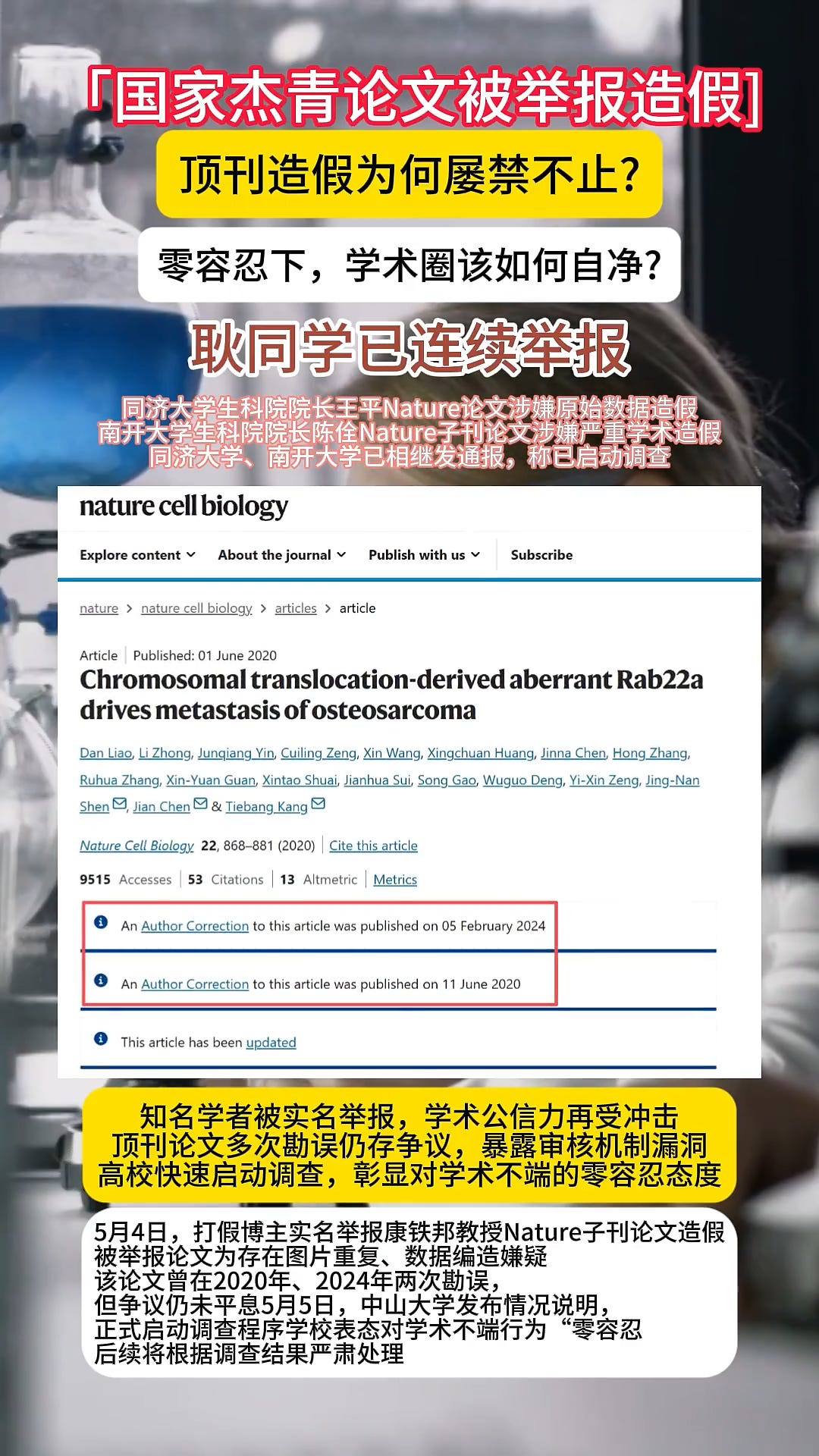

00:00:00:15 - 00:00:06:09
一个博士干翻三位985院长 中国科研的吹哨人来了
00:00:06:25 - 00:00:09:25
你以为学术圈是象牙塔 不
00:00:10:09 - 00:00:15:23
有时候它更像一座围城 里面的人不敢说外面的人进不来
00:00:16:14 - 00:00:19:14
直到一个名叫耿同学的北航博士生
00:00:19:24 - 00:00:23:26
用一台电脑 一腔孤勇 连续扒出同济大学、
00:00:24:00 - 00:00:29:11
南开大学、中山大学三位学法院长的论文造假 全网沸腾
00:00:29:28 - 00:00:34:13
这不是电影 是2026年最震撼的学术地震
00:00:35:00 - 00:00:38:24
耿同学不是圈内人 没有靠山 也没有利益牵扯
00:00:39:08 - 00:00:43:24
他只是看不下去为什么有人熬夜做实验拿不到项目
00:00:44:06 - 00:00:48:10
而有人靠PS几张图就能发Nature拿千万经费?
00:00:48:24 - 00:00:52:04
他一条条比对数据 一帧帧分析图像
00:00:52:16 - 00:00:55:16
把质疑做成连续剧发到彼岸
00:00:55:17 - 00:00:58:29
结果呢?同济院长王某被免职降级
00:00:59:04 - 00:01:04:02
难堪 陈院长被立案调查终身 康某也被推上风口浪尖
00:01:04:24 - 00:01:08:15
最离谱的是南开那篇论文六十四组数据
00:01:08:27 - 00:01:14:12
小数点后两位完全一样 概率是0 01的六十四次方
00:01:14:21 - 00:01:17:21
比中彩票海南网友笑称
00:01:17:21 - 00:01:21:20
这哪是实验数据 这是上帝亲手填的Excel表
00:01:22:09 - 00:01:26:10
可更让人心寒的是 这种事圈内人早就知道
00:01:26:27 - 00:01:30:19
但谁也不想惹院长 大家都要吃这碗饭
00:01:31:10 - 00:01:34:23
于是 沉默成了常态 造假成了潜规则
00:01:35:14 - 00:01:40:21
学生被压榨成学术耗材 成果被导师霸占 连抑郁都不敢说
00:01:41:10 - 00:01:45:15
广东某985高校硕士生言必率超50%
00:01:46:04 - 00:01:50:26
只因完不成4200 个实验或十四天的地狱指标
00:01:51:19 - 00:01:54:09
这还是科研吗?这是渡劫
00:01:55:07 - 00:01:58:09
而真正的代价是国家在流血
00:01:59:03 - 00:02:02:25
郭伟 江苏科大首席科学家 高中学历
00:02:03:17 - 00:02:06:17
靠伪造履历骗走千万经费
00:02:06:23 - 00:02:11:23
等新颖论文可疑 却被三封推荐信送进并级意愿
00:02:12:17 - 00:02:15:17
他们背后是一条完整的灰色产业链
00:02:16:00 - 00:02:19:03
代写悲哀造图买卖审稿意见
00:02:19:21 - 00:02:23:22
2024年黑道为出版社一次性撤稿8000多篇
00:02:24:02 - 00:02:27:16
中国作者占八成全球撤稿前十
00:02:27:16 - 00:02:30:25
机构七家是中国医院或医学院
00:02:31:17 - 00:02:36:18
我们总说要弯道超车 可如果赛道上全是作弊的车 怎么朝?
00:02:37:12 - 00:02:40:12
但梗同学的出现像一道光
00:02:40:24 - 00:02:44:07
他不是超人 只是一个不愿低头的年轻人
00:02:45:04 - 00:02:49:15
他的行动证明外行也能打假 只要敢较真
00:02:50:13 - 00:02:52:25
而国家也开始动真格
00:02:52:25 - 00:02:58:24
科技部启动专项整治 南开、同济迅速成立调查组表态零容忍
00:02:59:13 - 00:03:02:21
但这还不够 我们必须破五唯
00:03:03:06 - 00:03:07:23
破除唯论文、唯帽子为止 称唯学历、唯奖项
00:03:08:13 - 00:03:11:24
推行代表作制度 延长考核周期 引入
00:03:11:24 - 00:03:14:29
第三方监督 让造假者终身进入
00:03:15:23 - 00:03:19:04
更同学说我要为认真做科研的人发声
00:03:19:29 - 00:03:22:27
这句话值得每个中国人记住
00:03:24:00 - 00:03:25:11
因为科技的尊严
00:03:25:11 - 00:03:28:15
不在头衔里 而在真实的数据中
00:03:29:07 - 00:03:31:27
中国的未来不在PPT上
00:03:31:27 - 00:03:35:07
而在每一个不肯妥协的普通人手里


