Monotonic Decrease of Reflection Loss with Thickness When Material Characteristic Impedance Matches That of Free Space: A Mathematical Proof
Yue Liu
College of Chemistry and Chemical Engineering, Shenyang Normal University, Shenyang, China
yueliusd@163.com, ORCID: 0000-0001-5924-9730
Abstract
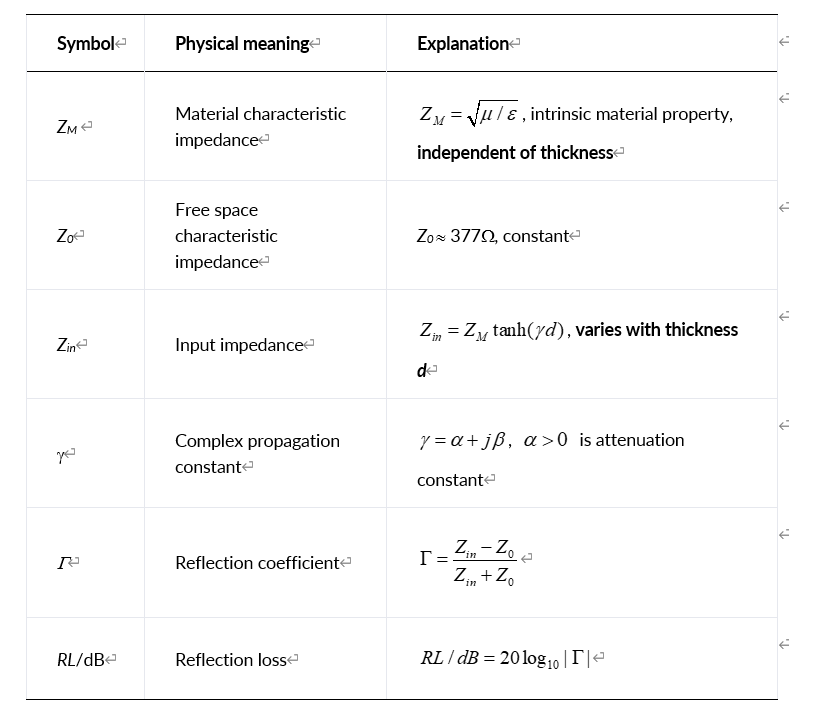
This paper rigorously proves that when a material’s characteristic impedance (ZM) equals that of the free space impedance (Z0), the reflection loss (RL/dB) monotonically decreases with increasing film thickness (d) at a fixed frequency, with no absorption peaks present. Through direct substitution of ZM = Z0 into the unmodified reflection loss formula and its mathematical simplification, we derive the exact relationship RL/dB = - 17.37ad, where a is the attenuation constant. Numerical verification confirms that both the unmodified and simplified formulas yield identical results, demonstrating strict monotonic decrease without fluctuations. Crucially, we clarify the fundamental distinction between two scenarios: (1) when ZM = Z0, the film’s microwave absorption behavior is identical to the material’s intrinsic absorption (governed solely by attenuation, with no wave interference effects); (2) when ZM != Z0, , the film’s absorption mechanism fundamentally differs from the material’s absorption due to wave interference effects. This work conclusively demonstrates that impedance matching theory contains logical flaws and should be abandoned, as it confuses ZM = Z0 with input impedance Zin = Z0.
In microwave absorbing material research, traditional impedance matching theory posits that optimal absorption occurs when the film input impedance Zin equals the free space characteristic impedance Z0, resulting in a confusion between Zin and the material characteristic impedance ZM. This theory implies the existence of an “optimal matching condition” for the incident microwaves entering the film, leading researchers to focus extensively on achieving the condition. [1, 2]
This paper proves that when a material’s characteristic impedance ZM (intrinsic impedance) matching with Z0), at a fixed frequency, the reflection loss RL/dB strictly monotonically decreases with increasing film thickness d, with no absorption peaks present. This conclusion is verified through direct numerical substitution into the RL formula, fundamentally challenging the traditional theory’s assumption of an “optimal thickness.” [3 – 5]
2. Critical Concept Clarification: Film Absorption vs. Material Absorption
2.1 Essential Distinction Between Two Scenarios
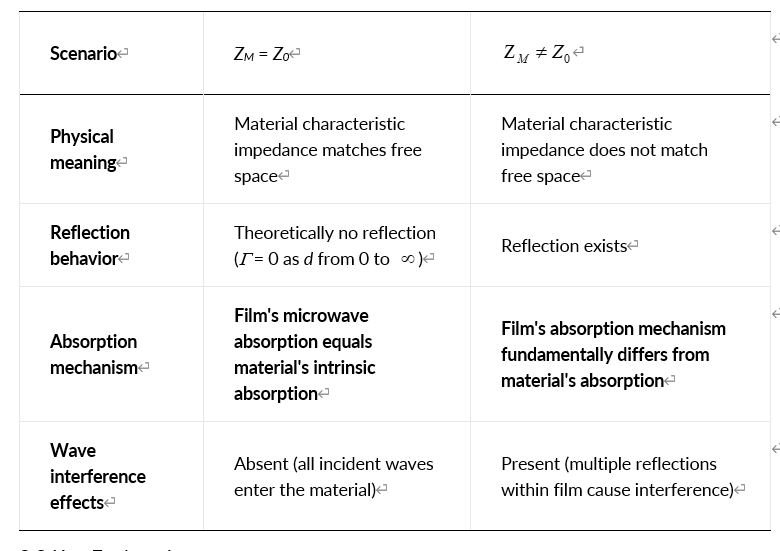
In microwave absorption theory, it is crucial to distinguish between two fundamentally different scenarios for interface reflection in metal-backed film:
2.2 Key Explanation
When ZM = Z0:
The material’s intrinsic properties already match free space, theoretically eliminating reflection at interface
All incident waves enter the material, with absorption determined solely by material attenuation
The metal-backed film’s microwave absorption behavior is identical to that of an infinite bulk material
Wave interference effects are absent (no reflected waves at the front interface of the metal-backed film)
RL/dB = - 17.37ad, strictly monotonically decreasing with thickness [3]
When
:
Material’s intrinsic properties do not match free space, resulting in reflection
Wave interference effects exist due to interactions between reflected waves
The film’s microwave absorption behavior fundamentally differs from the material’s intrinsic absorption [6]
RL/dB exhibits fluctuation with thickness d (multiple minima points)
Absorption performance is dominated by wave interference effects, not solely by material attenuation [7, 8]
Critical insight: When ZM = Z0, the film’s microwave absorption equals the material’s microwave absorption; when
, the film’s absorption mechanism fundamentally differs from the material’s absorption. These statements describe physically distinct phenomena under different conditions and are not contradictory.
[Preprints.org] Preprints ID: preprints-186039 - Your Preprint Is Declined for Announcement
发件人:
jade.zhou<jade.zhou@preprints.org>+
收件人:
我<yueliusd@163.com>
抄送人:
jade.zhou<jade.zhou@preprints.org>+
时 间:
2025年11月21日 09:44 (星期五)
Dear authors,

It is with regret that we must inform you that your following submission to Preprints has been declined for announcement:

Preprints ID: preprints-186039
Type: Article
Title: Monotonic Decrease of Reflection Loss with Thickness When Material Characteristic Impedance Matches That of Free Space: A Mathematical Proof
Authors: Yue Liu
Emails: yueliusd@163.com
Submission received: 2025-11-20

You may revise your manuscript according to our instructions here: https://www.preprints.org/instructions-for-authors.

We value the scientific community’s contributions to Preprints.org and encourage you to consider submitting your future work aligned with these guidelines.

If you have any questions, please contact us at info@preprints.org.

Best Regards,

Jade Zhou
Preprints Editor

Preprints Editorial Office
Email: info@preprints.org
https://www.preprints.org/

Disclaimer: The information contained in this message is confidential and intended solely for the use of the individual or entity to whom they are addressed. If you have received this message in error, please inform us by an email reply and then delete the message. You may not copy this message in its entirety or in part, or disclose its contents to anyone.
Re:[Preprints.org] Preprints ID: preprints-186039 - Your Preprint Is Declined for Announcement
I received notification (November 21, 2025) that my manuscript (ID: preprints-186039) was declined for announcement. The notification references “our instructions” but provides no specific explanation of what guidelines my manuscript violates.
I have reviewed Preprints.org’s instructions for authors and find that my manuscript:
1. Presents rigorous mathematical analysis within appropriate academic category
2. Contains no ethical violations or plagiarism
3. Falls within stated scope of Preprints.org
I respectfully request:
1. Specific identification of which guideline(s) my manuscript violates
2. Explanation of how rigorous mathematical proof challenging established theory violates Preprints.org policies
3. Identification of specific mathematical or logical errors, if such exist
4. Pathway for remediation if legitimate concerns exist
If Preprints.org’s policy is to suppress mathematical proofs challenging mainstream theories, this policy should be:
Made explicit in guidelines
Justified on scientific grounds
Applied consistently to all such work
Publishing decisions that cannot be justified on the basis of mathematical rigor or logical coherence undermine Preprints.org’s credibility and contradict its stated mission of providing unrestricted publication.
I await substantive response.
Respectfully,
Yue Liu
Thanks for reading yueliusd’s Substack! Subscribe for free to receive new posts and support my work.